
English Setter (Laverack)








Warning: Illegal string offset 'label' in /home/panda/sites/zoonika/wp-content/themes/zoonika/template-parts/animals/animals-param-item.php on line 32
Ð


Breed Description
Hunters have always sought to simplify their craft. To achieve this, they invented various tools. At one point, dogs came to their aid, and since then, every owner of a hunting breed has focused on improving its working characteristics. This was also true in medieval England, where breeders developed several types of pointing dogs.
They were called setters. This name comes from their habit of sitting and freezing in the direction of the discovered game. In English, “to set” means to establish or to point, but nowadays, “setter” refers specifically to a type of hunting dog. All setters of that time, specifically during the 15th and 16th centuries, were quite similar, but each variety had its distinctive features.
The English setter is the most compact and excels in finding game. The Scottish variety is bulkier and proves more successful in retrieving it, while the Irish setter is taller and nearly as good as the English one.
The ancestors of such passionate hunters are unknown. Some speculate that they could have been Spanish land spaniels. According to another version, their progenitors might have been early springers, old Spanish pointers, and water spaniels.
Around the 17th to 18th centuries, the English setter underwent significant changes. Through the efforts of Edward Laverack in the early 1800s, a distinct variety of English setters was established, characterized by a semi-sitting stance upon discovering game. Later, R. Purcell Llewellin made further alterations, resulting in a noticeably faster breed that took on a modern appearance. The contributions of these gentlemen to the development of the most widespread version of setters were so substantial that English setters are still occasionally referred to as Llewellin setters or Laverack setters.
It should be noted that in the line developed by E. Laverack, more attention was paid to the exterior and improvements in the dogs’ appearance. Initially, two dogs were acquired for breeding. After 35 years, the breeder achieved a stable result, whereas Llewellin focused more on upgrading the working qualities of English setters. His efforts also met with success.The breed was first recognized by the American Kennel Club in 1884, while the international kennel organization acknowledged it much later, in 1964.In our country, the breed was primarily of interest to the elite of society. However, the year 1917 brought significant hardships. Nevertheless, by 1940, more than 100 English setters were showcased at a dog show.

Appearance
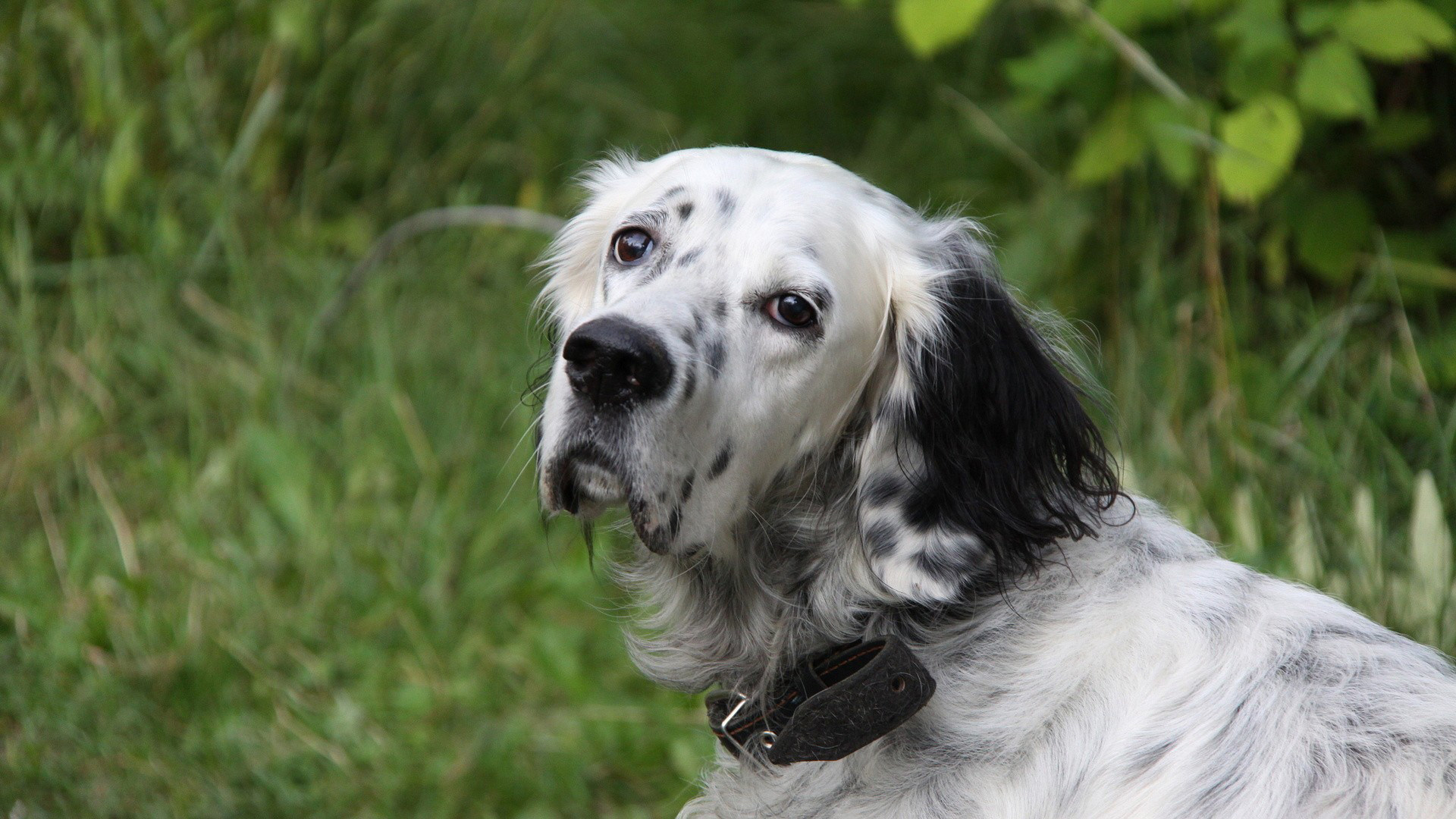
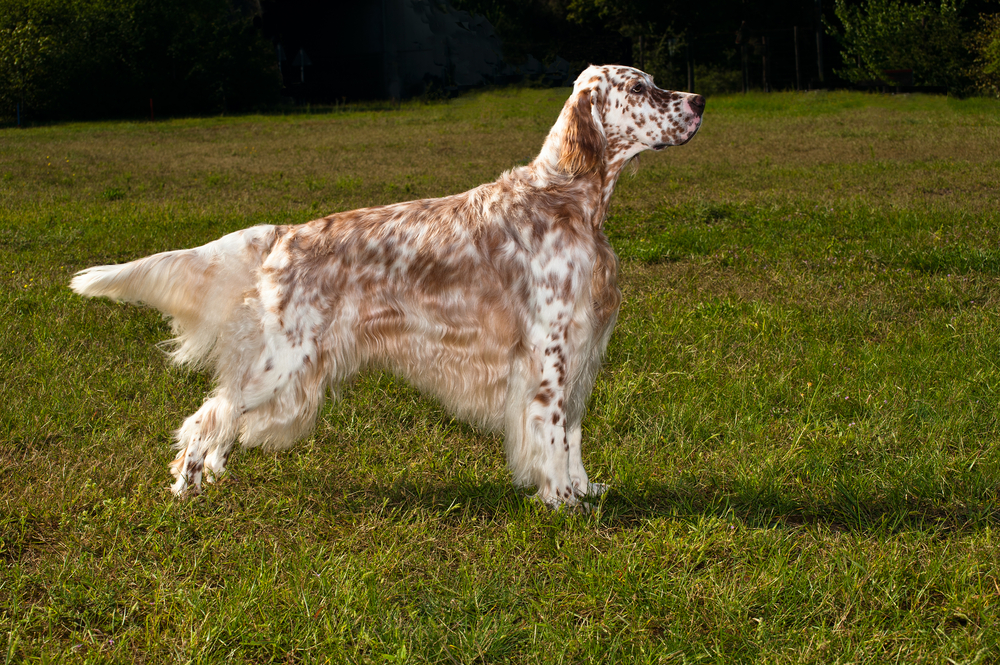
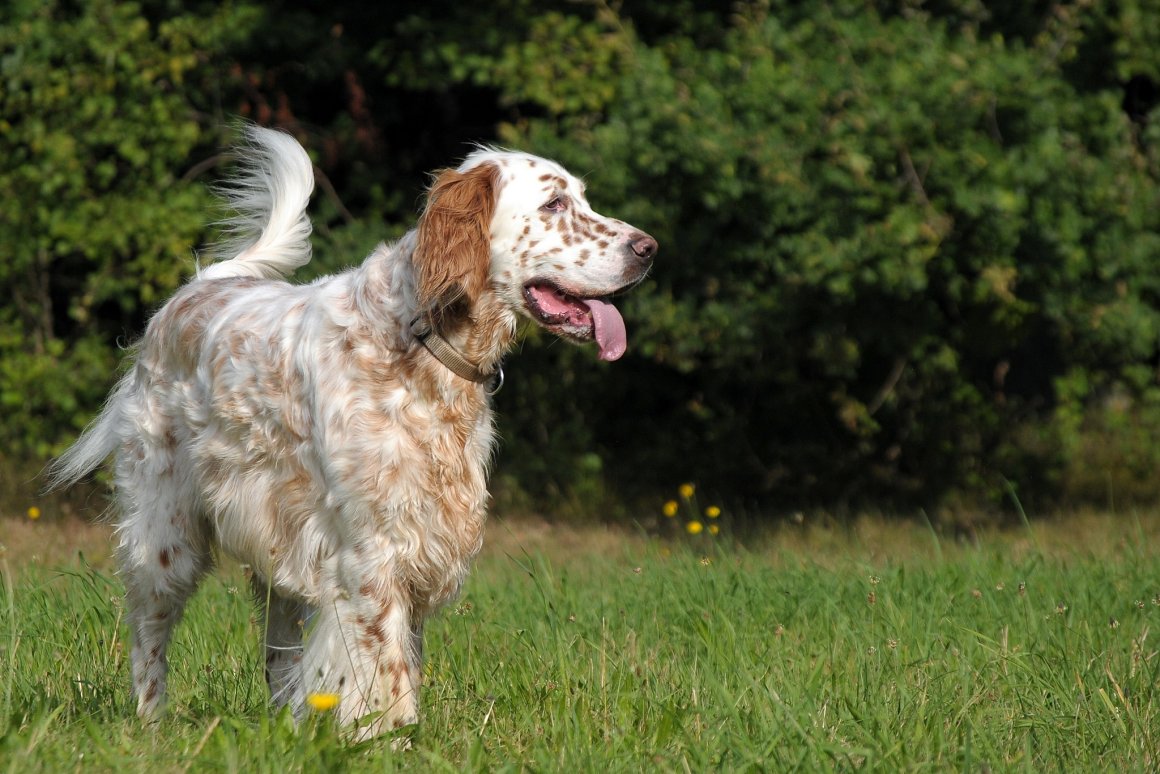
A gallant medium-sized dog. A true gentleman among hunting dogs. Ideally, its height at the withers is 65 – 69 cm, with a noticeable difference between sexes. Females are significantly shorter and more elegant, typically standing no more than 61 – 65 cm at the withers.
Active, lively, cheerful “English” dogs remain puppies for quite a long time. With an average lifespan of 10 – 12 years, they mature around 18 months-something to keep in mind when purchasing a puppy.
The rather lean body structure of the English setter resembles the Irish version of the breed. However, there is a noticeable difference in the weight of adult dogs, ranging from 20 kg (females) to 36 kg (males).
As excellent athletes, there are differences in appearance between working dogs and show animals. In general, working setters are not as robust as their Llewellin counterparts.
The “workers” are more compact, with less dense and beautiful coats, and their sense of smell is notably better.
The “show” version is more elegant, with noticeably denser and longer fur, and its hunting instinct is somewhat muted. But this doesn’t mean it’s absent, so both versions can become loving family companions and children’s favorites, as well as hunters or athletes.


Отличительные черты

Голова

Морда

Уши

Глаза

Зубы

Корпус

Конечности

Хвост

Шерсть

Окрас
Character
There is no universal description of a breed’s character. It depends on many factors, ranging from genetics to the specific environmental conditions the individual is in. Its upbringing and discipline also play a significant role in shaping certain character traits.
For instance, it’s unlikely to expect positive behaviors from a dog that is abused and kept on a leash, just as one cannot expect obedience and friendliness from a spoiled, unruly dog that acts on its whims.
Many dog breeders note that the character of the owner often matches the temperament of their pet. A cheerful and lively owner will likely have a similarly active dog that is obedient and good-natured. Conversely, an aggressive owner is more likely to have a mean, ill-mannered dog.
Nevertheless, certain key temperament traits are inherent to each breed, including Lagotto Romagnolos. At certain moments in a dog’s life, they behave similarly. For example, they love active games and long walks outdoors.
Among the positive qualities, we should mention their friendliness, sociability, and non-confrontational nature. Their love for games and their close ones is constant. A dog won’t lie down to sleep until at least one family member has also fallen asleep.
Their warmth extends even to the cats living nearby. However, this sociability can sometimes lead to sorrow: taking advantage of their friendly nature, malefactors might steal the dog during walks. Therefore, many dog owners buy collars with geolocation or insure their dogs against theft.What kind of relationship does an English Setter have with children? This company requires supervision, or else everything at home will be turned upside down. Lagottos mature quite late, so children under 12-14 years and dogs under 24 months need close watching. Naturally, everyone living with the pet should learn how to handle it.This abundance of positivity completely negates the chances of being a guard dog. Even as a security dog, an English Setter is unsuitable, as it sees friends everywhere. The only exception is for birds and rodents.A pathological fear of being abandoned makes the dog excitedly jump and ask for a walk whenever it sees a family member dressing up by the front door.In conclusion, an English Setter is also a wonderful imaginative creature and a cunning trickster.
Elite pointing dog
At the beginning of the 20th century, the nobility in Russia greatly esteemed this breed and considered it their duty to own a spaniel. Emperor Nicholas II loved English setters and enjoyed going hunting with them.Care and Maintenance
In the modern world, there are quite a few hunting dog owners living in cities who still choose to have pointing dogs. The English Setter ranks among the top on this list. City dogs can adjust to apartment living, but they require special attention for proper development. There are even advantages to this: the dog is almost always in sight, allowing the owner to monitor its growth and habits and often play with it. However, long walks are indispensable. Puppies should be walked 4 to 5 times a day for 20 to 30 minutes, while adult dogs need to be outside at least twice for 1.5 to 2 hours or more. It’s important to give the dog enough “breathing space,” allowing it to run freely and feel like a hunter – toys can help with this.
The Labradoodle Setter, like every family member, should have its own designated spot in the apartment. It’s best to arrange it in the quietest part of the home, away from balconies or heating appliances. Getting used to warm air can lead to coat problems, and if the dog’s bed is too close to a balcony door or in a cold area, it may suffer from frequent cystitis. Naturally, bathrooms, storage rooms, and kitchens are not suitable for a dog’s resting place. Storage areas and bathrooms lack natural light, while kitchens usually have food odors that can negatively affect a dog’s sense of smell and may encourage begging.
If the balcony is insulated and accessible, a doghouse can be placed there. It’s crucial that the bedding is flat and not too soft, with a low border along the edges to protect against drafts.
For owners of an English Setter living in a private house outside the city, it’s important to remember that a kennel can feel like a prison to the dog. This breed struggles with loneliness, so the dog’s space should definitely be indoors. The same recommendations for apartment living can apply, but the walking area should be thoroughly prepared. A fenced area with sandy soil is ideal. A fence less than 2 meters high may not keep stray animals out or prevent the dog from escaping. Of course, tethering the “Englishman” is a strict no-no, as a hunting dog needs space and the freedom to roam its territory. An undeniable benefit of having a Setter in a private home is the potential for self-training in preparation for hunting.
To maintain optimal condition, each pointing dog needs a well-chosen diet and feeding schedule. The Setter is no exception. When calculating portions, it’s important to consider not only the dog’s age, height, and weight, but also its individual traits: some dogs eat more, while others less. The smallest puppies up to 2 months old should be fed every hour six times a day, typically eating up to 2 liters of food. From 3 to 4 months, the number of meals decreases, but the portions increase: five times a day with a total of 2.5 to 2.8 liters of food. Then, from 4 to 6 months, puppies eat four times a day, gradually increasing the total amount to 4 liters. By one year, the Setter transitions to three meals a day, with portion sizes of 2 liters each. Afterwards, dogs are fed twice a day, increasing the portion to 3 liters. For those using commercial dog food, recommended portions will be indicated on the packaging. It’s essential to choose premium food that contains all necessary micronutrients and vitamins.
As for coat care, it should be brushed with special brushes at least once a week, ensuring that hair doesn’t get tangled at the joints and trimming excess hair between the toes.Nail trimming is highly individual; it is not advisable to cut the nails too short, as there is a blood vessel inside.Ear infections can be prevented by regularly inspecting the inner ear, especially after walks. Ears should be cleaned at least once a week with a cotton swab. Cotton swabs are not suitable for this, as they can damage the eardrum.It is quite easy to monitor the dog’s eyes: they are always in sight, and if there are excessive discharges, a visit to the veterinarian is necessary.

Unique hunter
The English setter is not afraid of water obstacles during hunts and enjoys navigating through thickets and marshes. Moreover, it also feels quite comfortable in steppes and fields.Training and Education
From the moment a puppy enters the home, it begins to learn. It tests various behaviors and selects those that work. To develop a true hunting dog, the owner must ensure that the established rules in the house are strictly followed. Certainly, yelling or physical punishment are unacceptable. The best method is to reward with treats, tone of voice, or petting for every successful step.
While the puppy is still developing immunity and is at home, it gets used to its name, place, toilet, leash, and collar. Approaching its designated spot, it should hear the command “place”-this helps it learn the lesson more quickly. If it falls asleep somewhere else, it’s essential to gently move the puppy and lay it down in its spot. This area should be associated with safety.
Training the puppy to use a pad can take a considerable amount of time. Patience is needed, and the owner should praise the little one every time the “business” is done in the right place. Meanwhile, the area covered with pads gradually decreases. Until the puppy is about 6 months old, and sometimes longer, the owner will need to monitor this closely.
The simplest commands can be practiced at home by the puppy’s owner. There’s no need to hire specialists to teach the young setter to sit, lie down, or shake paws. The owner must ensure that the pet clearly understands the commands “no!” and “stay close,” as these will be useful during walks.
Around 8 months, training for hunting can begin if a dog is needed for hunting. In other cases, canine centers can help with agility, coursing, and other sports in which the English setter will participate.
Some stubbornness and reluctance to do things stem from the high intelligence of the English setter. However, the owner can persistently and consistently address these behaviors even without the help of animal psychologists. Very effective results often occur when training starts with play or includes playful elements, as the setter is essentially an adult puppy before becoming a hunting dog. We feature the best who care for every puppy from the very first days of its life.

Setter stance
The setter has a distinctive stance that it adopts when it detects prey, thereby pointing the way for the hunter. This is also tied to the breed’s name.
How to Choose a Puppy
If you want to buy a family companion and participate in shows, it is recommended to take a closer look at the Labrador version of the setter. For hunting, the Llewellin is preferable. Of course, the English setter is the breed whose standard you should familiarize yourself with in advance, regardless of your intended use.
At breeding kennels, breeders will be able to answer all the nuances of care. However, dog breeding is a business, and it’s important to choose the best kennel.
Gender and color should be considered in advance. Buying toys and accessories for dogs is also part of the plan. It makes sense to visit several dog shows to see the beauty and characteristics of the breed firsthand. Additionally, on various forums discussing dog-related topics, inquire about the downsides of owning such a dog.
Pay attention to all the details at the kennel: living conditions, cleanliness, the behavior of the mother dog, the puppy’s pedigree, and veterinary passport indicating vaccinations and screenings for genetic diseases-all of this should be reviewed before making a purchase.
Naturally, all puppies are adorable, and you might want to take them all home. However, your chosen puppy should be active, proud, clean, with clear eyes free from corneal cloudiness, clean ears with no sour smell (a sign of inflammation), painless joints, and he should be over 2 months old. Find out how to do this at Zooinika and get an excellent pet.
Health and Diseases
It can be said that this is a relatively healthy breed. Of course, every dog has its own immune system and can fall ill with various diseases. However, the impressive working capabilities of the English setter indicate a tendency to some joint issues.
Hip dysplasia is a fairly common condition that also affects Labradors. Until they are 8 months old, it is strictly prohibited to navigate stairs in urban high-rise buildings. The risk of injury and improper joint formation at this age is significant. It’s better to use the elevator, while going upstairs can be done on foot. Jumping off chairs and sofas is also not recommended to avoid sprains.
Eye problems are a genetic predisposition. Progressive retinal atrophy can render a dog completely blind. At the first suspicion of poor vision (for example, if the dog clearly struggles to see objects during the day and bumps into them) or if signs of inflammation appear, such as discharge, it is strongly advised to visit a veterinary clinic immediately.
Limping, even if mild, can herald osteodystrophy. This often occurs when the dog’s diet lacks certain trace elements. An excess of particular nutrients, such as phosphorus and calcium, can also lead to kidney issues.
It is highly recommended to adhere to a schedule of deworming and vaccinations. During warm weather, it is essential to treat the coat with special sprays against ticks, which can be found on the Zoonica bulletin board.
Содержание
-
1. Описание породы
-
2. Внешний вид
- 2.1 Голова
- 2.2 Морда
- 2.3 Уши
- 2.4 Глаза
- 2.5 Зубы
- 2.6 Корпус
- 2.7 Конечности
- 2.8 Хвост
- 2.9 Шерсть
- 2.10 Окрас
-
3. Характер
-
4. Содержание и уход
-
5. Дрессировка и обучение
-
6. Как выбрать котенка
-
7. Здоровье и болезни






Comments
Only registered users can leave reviews.
Enter